
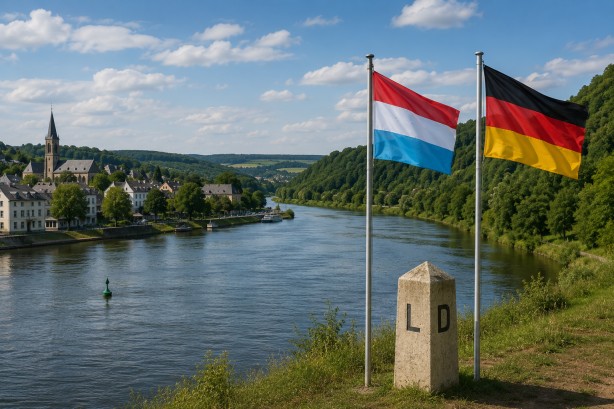
In a unique example of shared sovereignty, Luxembourg and Germany manage a border defined not by a conventional line, but by the jointly governed Moselle, Sauer, and Our rivers. This distinctive arrangement, known as the German-Luxembourgish condominium, places these waterways and related infrastructure like islands and bridges under joint control. The origins of this arrangement date back to the Congress of Vienna in 1815, when European borders were reconfigured after the Napoleonic Wars.
The foundation for shared ownership was laid under Article 25 of the Congress of Vienna’s Final Act, which allocated the rivers to both nations instead of dividing them along median lines. This agreement was further solidified by treaties signed in Aachen in 1816 between Prussia and the Netherlands, which then governed Luxembourg. Even as Luxembourg gained independence and Prussia integrated into the German Empire, the principles of the 19th-century agreements persisted, shaping the contemporary border management between the two countries.
For over a century, the status of bridges spanning these shared rivers remained ambiguous until negotiations initiated in 1979 addressed the issue. This led to a border treaty in 1984 that formally recognized bridges and footbridges as part of the shared territory. Today, both nations exercise a system of concurrent jurisdiction, allowing German and Luxembourgish laws to apply across the shared regions, with bilateral agreements in place to address any legal conflicts that might arise.
Law enforcement within this unique border area operates under a cooperative framework. Police from both countries are authorized to conduct joint patrols and can intervene in offenses occurring on the shared rivers or bridges. The jurisdiction for subsequent legal processes can vary, depending on factors such as the individuals involved and the specifics of the incident.
This arrangement stands as a rare instance of shared sovereignty in Europe, offering an alternative to conventional national boundaries. The German-Luxembourgish condominium continues to function as a collaborative model of border management, integrating historical agreements with modern governance.