
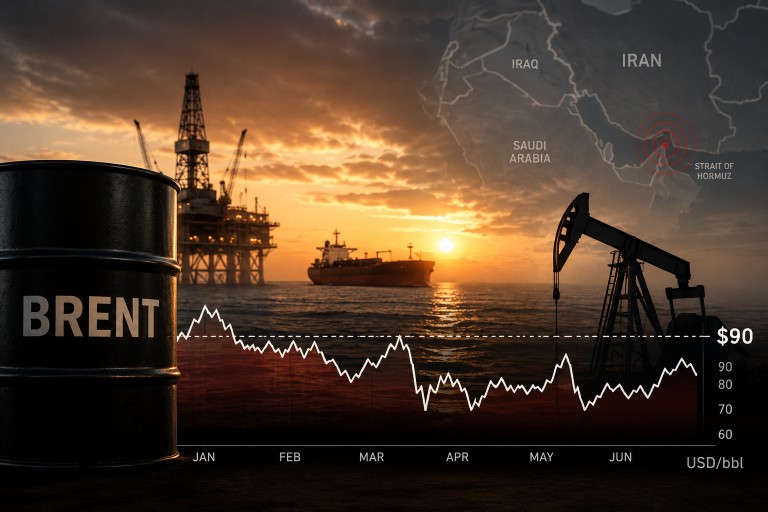
Brent crude oil prices have seen their most significant weekly surge since April, nearing $85, but further escalation above $90 per barrel might necessitate a more extended disruption in the Strait of Hormuz or clearer indications of tightening global supply. The U.S. benchmark, West Texas Intermediate, is also witnessing a rise, approaching $80. This surge follows renewed military tensions between the United States and Iran, which have unsettled Middle Eastern supply routes and reduced tanker movements through the crucial Strait of Hormuz, a channel that facilitates about 20% of global oil trade.
Despite these developments, Brent crude has found it challenging to breach the week’s peak of $87.55 per barrel, even though the conflict in the region has grown and movements through Hormuz have been considerably hindered. Analysts attribute this to a prevailing market sentiment that diplomatic solutions remain achievable, thereby capping further price increases. The market’s attention is fixed on potential sharp declines in global oil inventories and the possibility of a prolonged disruption in Hormuz as indicators for a potential price surge.
While military tensions have intensified, the oil market has remained relatively steady, with Brent crude trading within tight ranges in recent days. This stability suggests investor expectations that the current geopolitical tensions might de-escalate rather than escalate. The strategic importance of the Strait of Hormuz continues to be a significant concern for energy markets, with tanker traffic slowing and exporters seeking alternative routes to reduce reliance on this vital waterway.
The ripple effects of these disruptions extend beyond crude oil. In the United States, refining margins have increased as supplies of diesel and gasoline tighten. Concurrently, European fuel markets are experiencing similar pressures, exacerbated by a decrease in Russian fuel exports. These factors are contributing to a tightening global energy supply.
Market observers are closely monitoring two critical developments: the potential for significant declines in oil inventories that might indicate a supply shortage, and the success or failure of diplomatic efforts to resolve the situation. Until either of these scenarios unfolds, analysts anticipate that Brent crude prices will likely remain below the $90-per-barrel threshold, despite ongoing geopolitical tensions.