
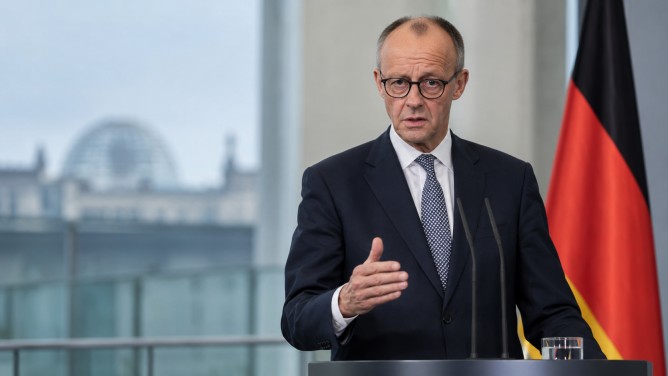
The recent regional elections in Germany have intensified scrutiny on Chancellor Friedrich Merz’s leadership, as his Christian Democratic Union (CDU) suffered significant losses while the Alternative for Germany (AfD) gained substantial traction. These results could lead to a shift in Germany’s political landscape, affecting both national policies and party strategies.
In Berlin, the left-wing Die Linke emerged victorious, capturing approximately 25.7% of the vote, positioning itself as the largest party in the region. The CDU trailed with 18.8%, while the AfD secured third place with about 16.3%. Meanwhile, in Mecklenburg-Western Pomerania, the AfD clinched the largest share of votes at roughly 38.2%, narrowly surpassing the Social Democrats, who garnered 35.5%. The CDU’s performance was particularly dismal in this region, receiving only 4.9% and failing to meet the 5% threshold required for representation in the state parliament.
These election outcomes signal a growing political divide within Germany. The AfD has strengthened its foothold in eastern regions, while Die Linke’s success in Berlin highlights a shift towards left-wing policies in urban centers. This divergence is expected to spark intense internal discussions within the CDU regarding its future direction and leadership under Merz.
Despite the setbacks, Merz has vowed to remain in his position, focusing on implementing his government’s economic and social reforms. However, the pressure mounts as the CDU grapples with the rise of the AfD, which also recently performed strongly in Saxony-Anhalt. These developments may force the CDU to reassess its strategic approach to regain voter confidence and counter the growing influence of the AfD.
The elections underscore the evolving political dynamics across Germany, reflecting broader societal shifts and regional disparities. As the CDU navigates these challenges, the results are likely to fuel ongoing debates about the party’s leadership and its approach to addressing the nation’s pressing issues.